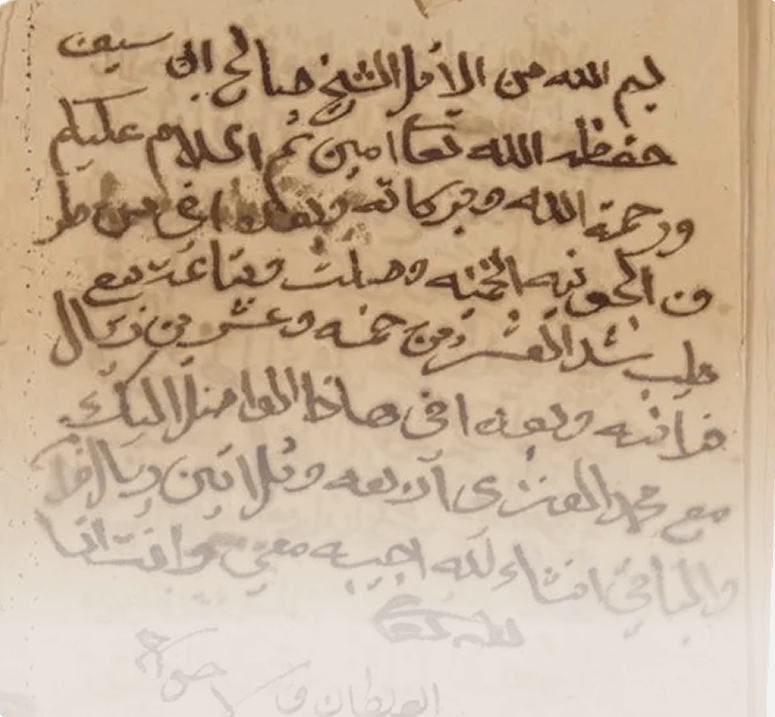

This article aims to document the commercial letters of Salem bin Abdullah Al-Ateeqi, written en route from Bombay, India, to Bahrain on a trade trip in Jumada al-Thani 1339 (February 1921). In his letters, Salem recorded a number of observations and notes about goods, prices, and merchants in India, Muscat, Kuwait, and Zubair. He interacted with a number of merchants during his travels, which gives his letters special significance, as they were documented during a single trip. These letters provide a model of Kuwait's commercial relations with India, the prevailing trade pattern, and the interrelationships among merchants operating in that area. Furthermore, they embody an ancient model of the concept of community and national unity. General Contentsasidjidj
This article aims to document the commercial letters of Salem bin Abdullah Al-Ateeqi, written en route from Bombay, India, to Bahrain on a trade trip in Jumada al-Thani 1339 (February 1921). In his letters, Salem recorded a number of observations and notes about goods, prices, and merchants in India, Muscat, Kuwait, and Zubair. He interacted with a number of merchants during his travels, which gives his letters special significance, as they were documented during a single trip. These letters provide a model of Kuwait's commercial relations with India, the prevailing trade pattern, and the interrelationships among merchants operating in that area. Furthermore, they embody an ancient model of the concept of community and national unity. General Contentsasidjidj
This trip occurred during the final days of the rule of Sheikh Salem Mubarak Al-Sabah (Rabi' al-Awwal 1335 - Jumada al-Thani 1339) (February 1917 - February 1921). Sheikh Salem's era was filled with events that had a direct impact on trade.Google The first was the reduction of customs duties on imported goods to 4%, which stimulated trade and encouraged merchants to expand their businesses.[1]
This included the installation of telegraph wires, which placed Kuwait in direct daily contact with the outside world.[2] Politically, relations with Sultan Abdulaziz Ibn Saud deteriorated, and the Ikhwan's activities increased, as did their attacks on Kuwait, such as the Battle of Hamdh in 1338-1919 CE and the Battle of Jahra in Muharram 1339 CE (October 1920 CE).[3] The British government also imposed a blockade on the entry and export of overland goods from Kuwait due to the war with the Ottoman Empire, which severely affected the population until the blockade was lifted on Safar 16, 1337 CE (November 20, 1918 CE).[4] Kuwait continued its leading role as a commercial port for the Arabian Peninsula and a stop for their caravans despite external threats, as it was the natural port of Najd.[5]
Many members of the Al-Atiqi tribe practiced trade, and their records recorded a steady relationship with India. Al-Atiqi's trade extended early to India, Najd, and Iraq. The first to become famous for trade was Abdullah bin Saif bin Ahmed Al-Atiqi, during the reign of the second ruler, Abdullah bin Sabah, and his son, Jabir bin Sabah. Abdullah and his son, Abdulrahman bin Abdullah bin Saif Al-Atiqi, were traders and ran their family's business from Kuwait. Saif bin Abdullah managed the company's branch in India, Sheikh Saleh bin Saif Al-Atiqi managed the Balad Al-Zubair branch, and Abdulaziz bin Mansour Al-Atiqi managed the company's branch in Souq Al-Shuyukh, which, along with Al-Zubair, was one of the most important trading centers for the people of Kuwait and Najd in Iraq. The documents left behind by them preserved some of this trade and the goods they traded, such as fabrics and foodstuffs. Some of this was covered in the articles: Document (15) and Document (16) on the Al-Atiqi website, which describe Al-Atiqi's commercial agencies and companies in the first half of the thirteenth century (nineteenth century AD)[6].[7]
[1]Abdul Aziz Al Rashid, "History of Kuwait," edited by Khaled Abdul Qader Abdul Aziz Al Rashid, 1926-2016, p. 425.
[2]Abdul Aziz Al Rashid, op. cit., p. 430.
[3]Abdul Aziz Al Rashid, op. cit., pp. 441, 449-457.
[4]Abdul Aziz Al Rashid, op. cit., p. 433.
[5]Ahmed Mustafa Abu Hakima, "Modern History of Kuwait," That Al-Salasil, 1985, p. 335.
[6]Document No. 15, Alateeqi.com website.
[7]Document No. 16, Alateeqi.com website.



